G o i n g i n t o H i s t o r y
Probably partly thanks to the always good-humoured Swiebertje from my youth, a television program for children in 1960 about a cheerful wanderer, I have a naive, romantic image of wandering. Just go where the wind takes you, carefree enjoying, confident that there is always someone who will take care of you if necessary. But what different are the stories about this in the book De Rondgangers (2017 Anthropodium-Phons Bakx), an anthropological study of peddlers and vagrants in the southern Netherlands and Flanders in the 19th and 20th centuries. There were walkers with perishable goods (such as the current caterers) and peddlers of longer-lasting walking trade (such as shoe polish, laces, haberdashery, potato peelers and the like). The latter tried to sell their wares at remote farms and for the farmers they were also the newspaper. They often turned out to have their own territory with fixed sleeping and eating addresses where they could return once every six weeks and within which they could not tolerate anyone else. How big was my disappointment when it turned out that it was exactly the same for vagrants. No lounging around or enjoying walking on its own. They had to move, because everyone had to work hard to keep their heads above water and then they could not afford or tolerate such a good-for-nothing every day around them. These are often sad stories about diseases that sometimes wiped out entire families, about infant mortality and poverty. People, who had been thrown out of society due to all kinds of adversity, were dependent of the mercy of Christian charity, whereby Catholics were more inclined to earn indulgences for themselves in this way than the somehow more sober and realistic Protestants. Beggars, who were completely polluted, slept among the animals and got food out of a secial bowl kept seperately for them and who were sometimes so covered with fleas, lice and other bites, which could transmit dangerous diseases such as typhus, that they finally were left to their own. So often they did not get very old. These life stories are pure tearjerkers. It ended badly for you if you could no longer manage. When it got very cold in the winter, some deliberately started stealing in order to have a roof over their heads in prison for a while. Although, of course you also had cheerful whistlers, who got everything done with a lot of charm and jokes and made people laugh with their tall tales or circus skills, stood upside down or sang improvised songs of life. This also applies to the market singer, who commented on recent events like our comedians. They were one of the few forms of entertainment at the time and because they came to so many places, they were sometimes also clever marriage mediators. There were also those who rendered good fortune to smugglers or, under the guise of a biscuit seller with a wheel of fortune, seduced the people to gamble and thus scrambled for a living. The anarchists among them were often mired in life, completely indifferent, even to their own bodies. While I always thought that these freebooters were the real bon vivants, ignoring all the rules of the game and the authorities, not worrying about a safe future, only wanted to be in the present. Preferably, of course, with sunshine and birdsong, butterfly flutter and floral scent. Nor had I ever realized the strong role of religion in vagrant life. All kinds of expressions refer to this. Entering the ship does not only mean that you have no money left, so you are bankrupt, but also refers to the ship of St. Renuyt that would take you to better places, but never arrives and will wander forever just like the vagrants and peddlers themselves, who were in the same boat together. With carnival the ship of fools revive. Professions such as window cleaner, chimney sweeper, postman and ice cream merchant are still the remaining ambulants.
At the Maria School, attached to the monastery with sisters from the South, carnival was actively celebrated with a real parade. I was dressed as a peanut Chinese (1962), a shoebox with peanuts in front of my belly, my pyjamas on, a long braid on my back and a cone-shaped hat of cardboard. I had never seen them walk like this and felt a bit ridiculous, but in the meantime I could of course have a peanut every now and then and it was a lot more interesting than peasant girl with an older sister's wide skirt tied around my waist, a diaper around my shoulders and a crepe paper cap from the year before. My mother was quite inventive to get all her children (14) to participate by simple means. From Phons Bakx's book I understood that the first Chinese, who came to conquer the world, really started this way, at stations shouting loudly peanut, peanut, lekka, lekka. It was only much later that everywhere the Chinese restaurants, laundries and sewing studio’s came about.
In the Middle Ages there were the crusaders, pilgrims and bandits, all connected to religion in one way or another. One went on a pilgrimage out of devotion, but also as penance for one's sins. In Catholicism, the thought of a sin was almost equal to sin itself, coming very close to desire, which was also very wrong. And who didn't need that, the comfort of desire? Escape in fantasy and of course later on suffer from regret and guilt? A pilgrimage was a kind of life insurance for a good afterlife. Earning an indulgence, a step closer to God. And you could do that also for someone else. For example, there were the professional pilgrims, who let themselves be paid by people who could not or would not go themselves, in order to ask a more favour to God in a vicarious way. A matter of investment. And with investments you never know in advance whether actual profit will be achieved. It's always been that way. If you had enough money you could take that risk and let someone else go for you instead, securing a piece of Divine attention never hurts. There were also always pilgrims who undertook such a journey purely out of curiosity and an appetite for adventure. Today it is not different. But society is much more individualistic, people prefer to think for themselves rather than surrender to the certainty of all restrictive religious rules and laws. Though most contemporary pilgrims are also looking for a kind of religious awareness, spirituality and especially for meaning, but not necessarily within this tradition. Their most common age category is around fifty to sixty years old. The moment of reflection, when all kinds of things in your life are already quite fixed; marriage, children, career. Usually there is still enough vitality to give life a new turn, a kind of last chance moment. Choices to consider. A now or never feeling. Time is running out. Many possibilities have already been closed. To have to say goodbye to this is sad as a kind of preparation for the ever closer end, the approaching death. The pragmatic Western man no longer sees death as a new beginning. This awareness of your own finiteness is more likely to worry about. Moreover, the welfare state now largely fulfils the role of charity. Fortunately, hospitality in remote areas still exists, but the population density determines the degree. The present-day tourist, who wanders around for a while only to quickly return to his comfortable home and income, buys himself illusions, which has nothing to do with the nomadic life of vagrants of only a century ago. It is more of a sporty, relatively cheap holiday. And actually I am not much different and I am happy to be able to go out well equipped with water- and windproof clothing and good mountain shoes and that only stray dogs can still be a real danger. In addition, I always have a helpline with my phone. Yet despite these certainties, every time I go on a multi-day hike, I get very nervous before leaving and super proud after returning home. The risks are so much less, but the desires and fears are still the same, just because we are no longer used going into nothingness.
When you walk, you would expect the world to become bigger. After all, you are an explorer. But in another sense it becomes clearer and therefore smaller. Only the body counts. Don't I get blisters? Do the legs keep working? Can I still handle the backpack? Where can I spend the night, where can I buy food? The primary needs. Then the immediate environment, which can mean both danger and pleasure. The weather plays an important role in this. Again with regard to that vulnerable body. Can I keep myself dry and warm? Do I not get overheating? Where are the limits of my being? What requirements does a landscape place on me? Not just a matter of survival, but also experience. What changes in me when the landscape changes? Are new nerve connections being made in the head along the way? Will the road pattern change there too? Walking on the road demands a lot from my body. To what extent can my thinking break away from that biological being? Today's pilgrim is often an explorer in search of himself.
The idea of a professional pilgrim immediately appealed to me very much, a great way of crowdfunding my project. As a visual artist, I find it increasingly difficult to keep producing work that, partly thanks to the persistent economic crisis and the now prevailing pandemic, I can hardly sell and which only makes the world and my sheds more crowded. However, I still have a great need for doing things. I can then convert that energy to walking. I bring my daily viewing, thinking and wondering together in words, photos, drawings and images in the book Overwegingen (In Dutch going by many ways means considerations and refers both to the way you take for wandering, but also to refers to thinking before, during and afterwards.(at first the book will be only in Dutch) which I offer my clients afterwards as a consolation, and if desired, of course together with a clean soul statement.
- shred at destination and give upwind
- to tie to a tree and leave it to chance
- to bury and decay slowly
- ritually burn it
The rates for carrying and destroying are a minimum of one day of sleeping and eating, which amounts to approximately 50 euros. Please contact me at tejavanhoften@zeelandnet.nl
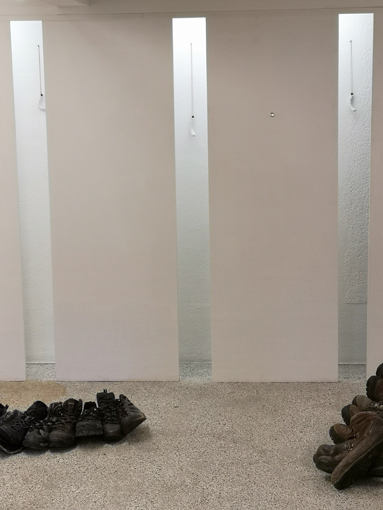
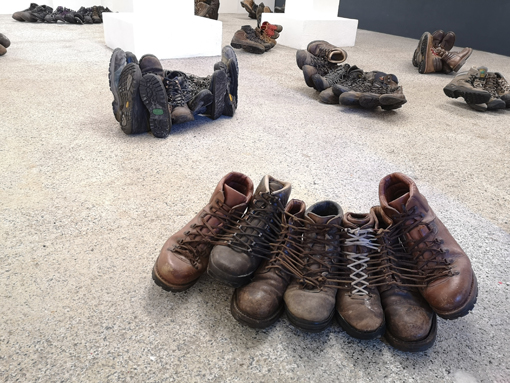
Now that corona makes it impossible for me to really travel, I am making images about being a pilgrim, about memories and the meaning of things. Things that have already had a life of their own, have experienced a lot. Some shoes have even known a second life after their walking existence, under plaster as a studio aid or handy shoe, or used in a stable with a strong scent of animals. It would be nice if one could find out exactly what the shoes have been through by odor analysis and also where those shoes have walked and thus compile an odour atlas following their traces. There are shoes that are completely worn out, with the footprint still in it after the 2400 km of the GR 5. Shoes that are almost falling apart and have just made the trip from Gouda to Rome with strings, tape and other aids. Where the African clay of Kilimanjaro still sticks to. Have been on an adventure in the swamps of Bali, where the leeches squeezed in through the lace holes. A Zeeland birdwatcher in Senegal, Gambia, Turkey and Eastern Greece scoring species for his personal spot collection. Soldier boots of a man, who at the age of 83 still walked the four days of Nijmegen of 40 km a day. Shoes received from relatives, cherished for years as a memory of a shared journey. Or shoes that still look like new, barely made progress because the owner could no longer walk due to health problems. The incredibly small children's mountain shoes of the first mountain hike of the now large, heavy man. Happiness and sadness that you carry with you or leave behind. Everything can be read from them. This too is becoming a special journey with the hiking shoe collection.
With thanks to all shoe donors
teja van hoften, 2021 05 02 Burgh-Haamstede, a part of my diary which I sended as an attachment with the invitation of the exhibition, due to the lack of an opening word.
My apologies for my poor English. corrections are appreciated